
Best Pokies in Tasmania: Hours, Rules and Randomness
 Available in AU
Contents
Venue opening hours do not necessarily show when pokies are operating, and random spins make “best-paying” claims difficult to interpret.
When Tasmania’s Pokies Are Open—and What the Hours Don’t Tell You
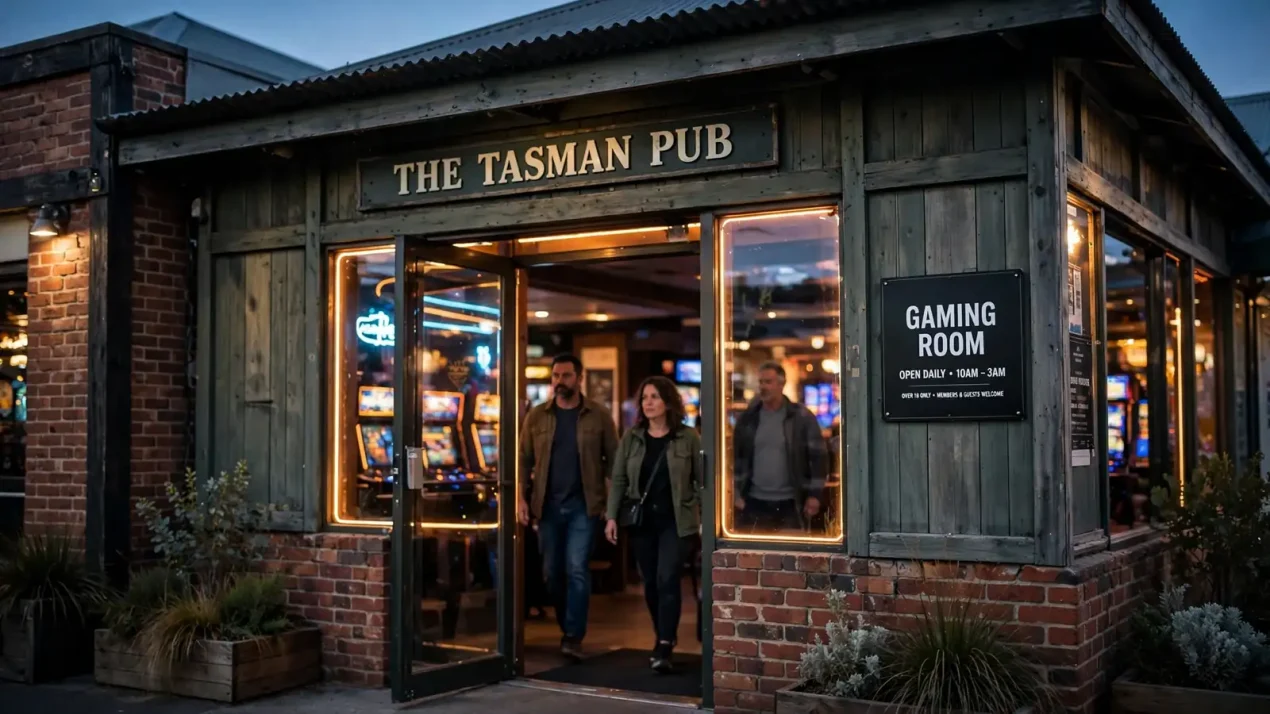
There is no single opening schedule that can be applied to every pokies venue in Tasmania. A listing may give the hours for the wider venue, while the gaming room can have its own operating times. Those details are not interchangeable: a venue being open does not, by itself, establish that its pokies are available.
That distinction matters when checking whether a venue is open now, opens early or stays open late. Online listings can be useful for narrowing down the answer, but the relevant detail is the gaming-room schedule, not simply the venue’s general trading hours. If the listing does not make that clear, it cannot settle the question. A direct confirmation from the venue is more useful than treating a broad opening-hours entry as a promise that the machines are operating.
“Open” is a blunt word. It may describe the doors, not the machines.
A further complication is that opening information can be presented in different ways: as a daily schedule, a general range of hours, or a notice that a venue is open without specifying which facilities are available. The practical reading is to look for hours explicitly tied to the gaming room or pokies. If the information only refers to the venue as a whole, it should be read narrowly. It confirms no more than the venue’s stated opening.
This is particularly relevant when a search concerns a specific time in the morning or late at night. A time-based result is not necessarily evidence that pokies are operating at that hour. Nor does a schedule at one venue establish the hours at another. The reliable unit is the individual gaming room, on the day in question.
The same caution applies to a venue name appearing in a broad list of places to visit. The name alone does not establish that it has pokies, that its gaming room is open at the moment, or that the room follows the venue’s full schedule. Those are separate details. When the distinction is absent, the information has limited use for planning a visit.
Pokies in Adelaide: Hours, Access and Venue Checks
A schedule should also be treated as information about operating hours, not as an explanation of what happens while the machines are running. From 1 July, venues with more than 20 gaming machines are required to have a dedicated responsible gambling officer (RGO) on duty while those machines operate. Region Riverina reported this requirement, alongside a one-month grace period for venues to remove signage and introduce RGOs. It is a staffing condition connected to machine operation; it does not set a shared opening time for Tasmanian venues.
That means hours and staffing answer different questions. A posted schedule may indicate when a gaming room is meant to operate. The RGO requirement concerns the arrangements that apply during operation at venues above the machine threshold. Neither fact can be used to fill in the other: a staffing rule does not show that a room is open, and a room’s stated hours do not reveal its staffing arrangements.
For a venue that falls within the threshold, the stated requirement is tied to the period when its machines are operating. It is not a general claim that every venue must have the same arrangement, regardless of how many machines it has. The distinction is material. A rule applying to venues with more than 20 machines should not be stretched into a description of every Tasmanian gaming room.
For checking hours, the useful sequence is straightforward: identify the specific venue, find information that refers to its gaming room rather than only the wider premises, and confirm any unclear or time-sensitive detail with the venue. A general listing can point in the right direction, but it may not answer whether the pokies are operating at a particular moment. No statewide timetable follows from the fact that Tasmania has gaming venues.
Do
- Identify the specific venue
- Look for hours tied to the gaming room
- Confirm time-sensitive details with the venue
Don’t
- Treat general venue hours as gaming room hours
- Assume one venue’s schedule applies to others
- Rely on broad “open now” search results
A search for “pokies open now” can therefore produce a result that looks more definite than it is. The wording may reflect a venue’s overall status, a standard schedule, or information that is not specific to the gaming room. Before relying on it, check exactly what the hours describe. If the entry does not distinguish the gaming room, that distinction remains unresolved.
The same applies to familiar names or broad labels attached to a location. A name does not verify a particular gaming-room schedule. Hours should be checked venue by venue, and a change in one venue’s arrangements should not be assumed to apply elsewhere.
The useful takeaway is modest: opening information is local, and the word “open” needs context. Check whether the hours refer to the pokies themselves, then treat the RGO rule as a separate operating requirement for venues with more than 20 machines from 1 July. No shared timetable.
What “Best-Paying” Means When Every Spin Is Random
Choosing pokies sites in Tasmania for 2026 calls for a look at the practical details available for each operator, such as licensing, minimum deposits and payout methods. Use these notes as a starting point when deciding which options to research further.
1. Lucky Dreams
License: Curacao · Min. deposit: A$20 (POLi)
Lucky Dreams lists a Curacao license and a A$20 minimum deposit via POLi.
2. GoldenCrown
License: Curacao Gaming Control Board OGL/2023/176/0095 (Hollycorn N.V.)
GoldenCrown lists a Curacao Gaming Control Board license, OGL/2023/176/0095, held by Hollycorn N.V.
3. Wild Tokyo
License: Curacao · Payout speed: crypto 30-60 minutes, fiat 1-5 days · Min. deposit: A$10
Wild Tokyo lists a A$10 minimum deposit. Its stated payout speeds are 30–60 minutes for crypto and 1–5 days for fiat.
4. Ricky Casino
Payout speed: crypto under 1 hour, PayID 1-3 business days · Min. deposit: A$20 (A$30 to qualify for the bonus)
Ricky Casino lists a A$20 minimum deposit, with A$30 required to qualify for the bonus. Its stated payout speeds are under an hour for crypto and 1–3 business days for PayID.
5. JustCasino
License: Curacao Gaming Control Board
JustCasino lists a Curacao Gaming Control Board license.
6. Uptown Pokies
License: Curacao (operating since 2017) · Min. deposit: A$20
Uptown Pokies lists a Curacao license, has been operating since 2017, and has a A$20 minimum deposit.
7. WinSpirit Casino
License: Curacao eGaming OGL/2024/923/0383 (Antillephone N.V.) · Min. deposit: A$30
WinSpirit Casino lists a Curacao eGaming license, OGL/2024/923/0383, from Antillephone N.V., and a A$30 minimum deposit.
8. JeetCity Casino
License: Curacao eGaming (Dama N.V.)
JeetCity Casino lists a Curacao eGaming license held by Dama N.V.
9. Rollero Casino
License: Curacao Gaming Control Board OGL/2023/176/0095 (Hollycorn N.V.)
Rollero Casino lists a Curacao Gaming Control Board license, OGL/2023/176/0095, held by Hollycorn N.V.
10. MrPacho
Payout speed: crypto 30-120 minutes, fiat 24-72 hours · Min. deposit: A$30
MrPacho lists a A$30 minimum deposit. Its stated payout speeds are 30–120 minutes for crypto and 24–72 hours for fiat.
“Best-paying” sounds like a straightforward label: find the pokie with the strongest return and expect it to give more back. In practice, that phrase can blur two different things. One is the game’s presentation — its theme, features and advertised appeal. The other is its return-to-player setting, or RTP. The first can attract attention. The second is a percentage used to describe a game’s return over time, not a forecast of what will happen in a particular session.
A specialist review reports that some providers let casinos select between more than one RTP setting for the same pokie. Where that arrangement applies, the game’s name and appearance alone do not establish which setting is in use. The same title can therefore have different stated return percentages at different casinos. That is the detail an attractive game page may leave in the background.
I have seen how the word “best” does its work. It turns a comparison into a verdict, although the information behind the verdict may be incomplete. A prominent feature or lively presentation can make a pokie look generous without saying anything conclusive about its RTP setting. And even a clearly stated setting describes a statistical property, not a promise that a player will receive a particular amount back.
Brisbane Pokies: Venue Hours and Local Checks
That distinction matters when comparing pokies in Tasmania. A familiar title at one venue is not automatically equivalent, in return terms, to the same title elsewhere. The setting matters; the label alone does not settle it. Where a return percentage is not clearly stated, it should not be filled in from the game’s reputation, its animations or a run of apparent wins. Those are different kinds of information.
RTP is also easy to read too personally. It is not a schedule of payments, and it does not mean that a portion of each person’s stake is held aside and returned after a set number of spins. The figure concerns the game’s design over time. A short visit, or even a long one, can produce results that differ sharply from that broad measure. No individual session has to match it.
The reason is the way the game produces outcomes. A Random Number Generator determines each spin separately. A previous result does not make a win more likely on the next spin, and a long losing run does not create a debt that the pokie must repay. The machine is not remembering a player’s sequence and adjusting the next outcome to balance it.
That is where “due” becomes misleading. I have heard the reasoning at a counter: a feature has not appeared for a while, so surely it is close. But the last spin does not provide evidence about the next one. Each outcome stands on its own. A run of losses may feel like a pattern, and a cluster of wins may feel like momentum, but neither tells what the next result will be.
Each pokie spin is an independent event determined by a Random Number Generator, meaning previous results do not influence the likelihood of a future win.
This also changes how a claimed “best” option should be understood. A higher RTP setting, if it is confirmed, is not a way to predict when a win will land. It cannot turn random outcomes into a sequence that can be timed or read. It is one piece of information about the game, and it must not be confused with certainty about a session.
For casino pokies in Tasmania, the useful distinction is modest but important: game appeal is not the same as return setting, and neither one predicts the next spin. A title can be entertaining and still leave the setting unclear. A stated RTP can be informative and still say nothing definite about the result ahead.
No spin owes anything.
Getting to a Pokies Venue from the Airport or CBD
A location search is a starting point, not a route plan. “Near the airport” can mean different things depending on which Tasmanian airport is involved, while “near the CBD” depends on the town or city and the exact point used as the centre. A broad label such as “north Tasmania” covers an area, not a single destination. The useful detail is the venue’s own address.
I learned to separate the place being searched from the place a person is actually trying to reach. A result may appear close on a map while still being awkward to access from an airport, accommodation or a CBD address. The pin alone does not settle that. Check the full street address and match it to the intended destination before setting off; if the venue’s own information is unclear, confirm the address with the venue rather than relying on a map label.
Best pokies in Canberra: hours and availability
That is also why “near me” is not a reliable measure of convenience by itself. It reflects the device’s location and the map’s results, not the reason for the trip or the route that suits it. A venue can be geographically close but poorly placed for the rest of the journey. Conversely, a venue outside a central area may fit a planned trip better. Distance is only one part of the decision.
Airport searches need the same care. Tasmania is not a single arrival point, and an airport search does not establish that pokies are located inside the terminal or immediately beside it. The phrase “at the airport” can be read as an on-site claim; “from the airport” is a journey question. Those are different things. I would not treat a search result or a loose location description as proof of an in-terminal venue. The address is the practical check.
For CBD searches, the same distinction applies. A central-area label is not a venue list, and a result’s position on a map does not tell the whole story of getting there. When comparing options, the useful checks are straightforward: the venue’s stated address, whether it matches the intended town or area, and whether the journey begins at the airport, a CBD address or somewhere else. Keep the destination specific. Broad searches can blur separate places together.
Attention: In Australia, gambling is strictly restricted to people aged 18 or older, including online pokies, regardless of venue accessibility.
There is also a firm eligibility point that does not change with distance. In Australia, gambling is restricted to people aged 18 or older, including playing pokies online. Being near a venue, travelling with other adults or arriving from an airport does not alter that age requirement. It applies regardless of how accessible a venue may appear.
I used to see how a “nearby” label could do more persuasive work than it deserved. It suggests ease, but it cannot confirm the address, the route or whether the place matches the intended destination. Treat location wording as a pointer, then verify the venue’s address before making the journey. That is a small check, not a guarantee of convenience. Location first. Details second.
How Tasmanian Pokies Venues Handle Gambling Incidents
A venue’s response to gambling harm is not only a matter of who is on the floor. A report by regionriverina.com.au says venues will be required to keep a gambling incident register, documenting occurrences that include a patron showing behaviour suggesting they may be at risk of, or already affected by, gambling harm.
The register is a record of events, not a ranking of venues or a measure of how enjoyable their pokies are. Its purpose is to make incidents visible in the venue’s own operations: what happened, and whether the situation involved signs of gambling harm. That matters because a single interaction can otherwise remain an informal recollection rather than something recorded for oversight.
There is a separate staffing requirement. From 1 July, a venue operating more than 20 gaming machines must have a dedicated responsible gambling officer (RGO) on duty while those machines are running. The two measures work differently. The RGO is a person assigned to a role during machine operation; the register is a means of recording relevant incidents. One does not replace the other.
Pokies in Sydney: What Search Results Can Confirm
That distinction is practical. Staffing describes who is present in a defined capacity. A register describes what the venue is expected to document. A venue could have the required officer on duty and still need to keep a record when an incident occurs. Conversely, keeping records does not itself meet the separate staffing requirement where it applies.
The word “incident” should not be read as meaning that harm must already be confirmed. The report includes behaviour that indicates a patron may be at risk, as well as behaviour suggesting they are affected. The threshold described is therefore about signs of concern, not a formal diagnosis. That gives the record a preventive dimension: the event can matter before its consequences are fully known.
From inside venue operations, this is the difference between a control that is visible on a roster and one that becomes visible through documentation. A roster can show that the designated role was covered; a register can show that a concerning occurrence was recognised as something to record. Neither, by itself, establishes how well a venue handles an individual situation. The existence of a process is not proof of its quality.
This is why searches for a “best” pokies venue cannot be answered by treating incident procedures as a scorecard. The register requirement concerns venue accountability, not machine performance, atmosphere or customer service. It also does not mean that every venue has the same staffing obligations: the RGO rule is tied to the number of machines and their operation, while incident recording is a distinct requirement described in the report.
Gambling Incident Register
A record documenting occurrences where a patron shows behaviour suggesting they may be at risk of, or affected by, gambling harm.
Responsible Gambling Officer (RGO)
A dedicated officer required to be on duty at venues with more than 20 gaming machines while those machines operate.
For anyone comparing Tasmanian venues, the useful point is narrower than a recommendation. A gambling incident register is intended to leave a record when behaviour raises concern; a responsible gambling officer is a designated person on duty under the separate threshold-based rule. Records and staffing. Different controls.
Online Pokies, the Spirit of Tasmania and the Limits of What’s Verified
A search for pokies aboard the Spirit of Tasmania can blur two separate questions: what gambling services a ferry provides, and whether an online service can be used while travelling. A search phrase is not evidence of an onboard pokie room, a casino service or permission to play online. I would not treat a result or an advert as confirmation of any of those things. Claims about specific onboard facilities need direct, current confirmation from the ferry operator.
The same care applies to searches that attach “Tasmania” to Crown or another casino name. A place name in a phrase does not establish that a venue exists there, that it has pokies, or that a particular service is available. Those are separate claims, and they should not be folded together because they appear beside one another online.
Online play raises a different issue from venue facilities. Under the Interactive Gambling Act 2001, companies cannot legally offer real-money online pokies to people in Australia without a domestic licence. None has been issued, so there is no Australian-licensed online casino. An offer described as a “no deposit bonus” does not change that position. The wording is promotional; it does not create a local licence or make an unlawful service lawful.
Offshore gambling sites may still be visible online, but visibility is not the same as Australian approval. The Australian Communications and Media Authority blocks illegal offshore gambling sites, and internet service providers must comply with its blocklist. Even where an offshore casino accepts a customer, Australian players have no legal recourse in Australia if it refuses to pay winnings. That is a material risk, not fine print.
Best Pokies in Perth: Hours, Venues and What’s Verified
I have seen how an attractive offer can pull attention toward the amount advertised and away from the terms that control access to winnings. With offshore services, the more basic issue comes first: the operator is not covered by an Australian online-casino licence, because no such licence exists. A bonus headline cannot resolve that gap.
The practical distinction is plain. A ferry-related search does not confirm onboard gambling facilities; an online offer does not establish lawful Australian provision. These are different questions, and neither should be answered by assuming that a familiar name, a local reference or a promotional phrase proves more than it does.
No shortcut here.
Why 24-Hour Availability Depends on the Venue
A search for pokies available around the clock can make opening hours look like a statewide question. They are not. A venue’s schedule is a local operating decision, and the fact that pokies are present does not establish that they run through the night. Nor does a general listing settle whether a particular gaming room is open at the time it is checked.
I have seen how easily “open now” can be read as a promise about the machines rather than the venue as a whole. A building may have other services with different hours, while the gaming room follows its own operating schedule. The useful detail is therefore the current information for the specific venue and gaming area, not an assumption drawn from another location or from a broad label such as “24-hour pokies”.
There is also a staffing condition to keep separate from opening times. A report by regionriverina.com.au says that, from 1 July, a venue operating more than 20 gaming machines is required to have a dedicated responsible gambling officer (RGO) present while those machines are running. The condition links the officer’s duty to machine operation. It does not, by itself, set the venue’s hours or establish that any Tasmanian location operates continuously.
Pokies in South Australia: What the Evidence Shows
That distinction matters when interpreting late-night availability. The staffing rule describes what must be in place when the relevant machines are operating; it is not a licence for a venue to extend its schedule, and it is not evidence that a particular venue stays open overnight. A machine count and an operating schedule answer different questions.
For anyone comparing Tasmanian pokies hours, the practical check is the venue’s own current opening information, with attention to whether it refers to the gaming room rather than the wider premises. If the listing is unclear, direct confirmation from the venue is more useful than treating “open now” as a guarantee. Hours can also be presented in ways that do not distinguish between a general venue and its gaming facilities.
The threshold in the reported rule is specific: it applies to venues operating more than 20 gaming machines, and the RGO must be on duty while those machines are active. It should not be stretched into a claim that every venue has the same staffing arrangement, or that smaller venues follow identical requirements. Different question.
What the Word “Pokies” Leaves Out: Randomness and Limits
“Best” can describe a theme, a feature or a player’s preference. It cannot make a particular result more likely on the next spin. Each pokie spin is an independent event, determined by a Random Number Generator. A run of wins does not mean a machine is due to pay, and a stretch without a win does not make a payout overdue.
I have seen how easily a session’s story gets mistaken for a pattern. A machine may appear to be warming up, or to have gone cold; those descriptions capture an impression, not a reliable signal about what comes next. The previous spin does not set up the next one. That distinction matters when comparing pokies in Tasmania, just as it does anywhere else.
A maximum bet or a maximum cash payout is a different question from whether a game is likely to return money. Those terms concern the bounds attached to play or a possible payout, not a forecast of what a particular session will produce. Without specific information about a game and its conditions, a general claim about either would be misleading.
The practical controls are less dramatic than a promise of a “hot” machine, but they address decisions a player can actually make. Deposit limits set a boundary on how much can be put into play. Loss limits set a boundary on losses. Session-time limits constrain how long a session continues. Self-exclusion is a way to step away from gambling rather than rely on a change in fortune.
The mechanisms are not interchangeable. A deposit limit concerns money going in; a loss limit concerns the amount lost; a time limit concerns duration. Self-exclusion is a stronger separation from play. These are standard responsible-gambling tools, but they do not change the random nature of spins or turn a limit into a prediction about results.
In practice, limits work best as decisions made before the pressure of a session builds. Once play is underway, a near miss or a small win can make extending the session feel reasonable. The machine has not altered its odds because the player has stayed longer. The boundary is there to govern the session, not to improve the outcome.
That is the part the word “pokies” leaves out: the machine offers an experience, but the outcome remains random, while the useful controls sit around the player’s spending and time. There is no dependable system in a sequence of past results. Limits, not patterns.
Online Pokies Searches and the Australian Legal Reality
The phrase “online pokies” can make a digital service sound like the same product found in a local venue, simply moved onto a screen. Legally, that comparison does not hold. The Interactive Gambling Act 2001 prohibits operators from providing real-money online casino games to people in Australia, and no Australian-licensed online casino exists.
That distinction matters when a Tasmanian resident looks for casino-style play online. A site’s willingness to accept an Australian customer does not make it locally licensed or give it the protections attached to an Australian casino licence. There is no domestic online-casino licence to check. The law’s focus is on the operator supplying the service, not on prosecuting an individual for playing. Australians may legally play on offshore sites that accept them, but that does not turn those services into Australian-regulated casinos.
I have seen “available to Australians” used as if it meant “accountable in Australia”. It does not. Availability is a commercial decision by an offshore operator; local oversight is a separate matter. The wording sounds reassuring. The protection is not there.
The practical difference becomes clear when a dispute concerns a withdrawal. If an offshore casino refuses to pay winnings, an Australian player has no legal recourse in Australia to compel payment. A balance shown on a screen is not the same as money held under an Australian casino’s domestic obligations. The operator’s terms may describe a complaints process, but that process does not create Australian legal recourse.
This is why searches for the best-paying pokies in Tasmania cannot be answered by treating an online claim as a local venue comparison. A displayed return figure, prize claim or promotional description does not establish that a service is licensed here, or that a player can enforce the terms here. Those are different questions from how a game is described.
The same applies to searches for online play “near” Tasmania or for higher-limit options. A website’s location, branding or apparent access from the state does not establish local authorisation. Nor does the word “casino” in a business name prove that the service is an Australian-licensed online casino. There is no such licence.
The distinction is plain, even when the marketing is not: operators are prohibited from supplying real-money online casino services to people in Australia, while the law does not target individual players. Offshore access does not supply Australian consumer protection, and refusal to pay leaves no Australian legal remedy. Availability is not protection.
Legal Risk
No Australian-licensed online casinos exist; players using offshore sites have no legal recourse in Australia if the operator refuses to pay winnings.
Pokies in Tasmania’s CBD: Venue Rules, Not a Venue Ranking
A CBD address or a club label does not, by itself, tell much about how a venue’s pokies are managed. The operational detail that matters here is the number of machines and whether they are running. A report by regionriverina.com.au says that, from 1 July, a Tasmanian venue operating more than 20 gaming machines is required to have a dedicated responsible gambling officer (RGO) on duty while those machines are in use.
That condition is tied to the machine count, not to whether the venue is a club, hotel or casino, nor to whether it sits in a city centre. A venue below the stated threshold is not covered by this particular staffing requirement; one above it is, during machine operation. The rule is about an on-duty role, not a badge that can be displayed while no one is available to perform it.
This is a more useful way to assess a CBD venue than treating “best” as a simple label. A ranking can make a venue appear preferable without explaining what is being compared. Machine numbers, location and venue type do not establish a ranking, and the RGO requirement is not a rating of the games or a promise about outcomes. It describes one aspect of venue operation.
I have learned to look past the promotional shorthand. “Club pokies” describes a category people may use when deciding where to go; it does not explain whether the staffing threshold applies at a particular venue. The distinction is plain. A rule has a condition, and the condition has to be met.
The same point applies to searches for pokies in Tasmania’s CBD. The relevant question is not simply whether a venue is central, but whether its operating circumstances bring it within the requirement. From the stated rule, that means more than 20 machines and an RGO on duty while they are operating. A venue’s name or postcode cannot substitute for those details.
Self-exclusion is a separate responsible-gambling measure, not a way to identify or rank CBD venues. Venue rules and individual support options answer different questions. Keeping them separate avoids turning a staffing requirement into a broader claim about what a club offers. A narrow rule, read narrowly.
Cashless Searches and What They Don’t Establish
“Cashless” can describe how money is handled, but it does not identify a particular payment arrangement. A venue might use the word to refer to one part of a transaction, while other steps still involve cash or a separate system. The label alone says little about what happens at the machine or elsewhere on the premises.
I have learned to treat labels as a starting point, not an operating manual. A description of cashless pokies in Tasmania does not, by itself, establish that a specific venue has removed cash, how its machines are funded, or what payment methods it accepts. Those are separate details. A venue name or location in the same search does not settle them either.
There is another distinction worth keeping clear: payment arrangements and responsible-gambling controls are not interchangeable. Deposit limits, loss limits and session-time limits can help set boundaries, while self-exclusion can restrict access to gambling. These are standard responsible-gambling tools. Their availability does not prove that a venue is cashless, nor does a cashless arrangement necessarily mean those controls are in place.
The language can make the two subjects sound connected. “Cashless” may suggest that spending is easier to track or control, but that impression is not a description of a venue’s actual safeguards. The practical questions remain separate: how funds are handled, what limits can be set, and whether self-exclusion is available.
I would not use the word as a verdict on a venue. It is a broad label, and the mechanics sit behind it. Check the specific payment process and the responsible-gambling options as distinct matters; one does not confirm the other.
A label is not a control.
Are online pokies legal for Australian players?
Yes, Australians can legally play on offshore sites that accept them, but companies cannot offer real-money online pokies to Australians without a domestic licence, and no such licences have been issued. If an offshore casino refuses to pay, players have no legal recourse in Australia.
What is the legal age for online gambling in Australia?
You must be 18 or older to gamble online in Australia.
Can casinos change the RTP of their games?
Yes. Some providers let casinos choose between multiple RTP settings for the same game, so check the stated RTP at the casino offering it.
What is the cost-benefit calculation of casino promotions?
Check the wagering requirement, what amount it applies to, and any cash-out cap on free-spin winnings. For example, a $500 bonus with a 40x requirement means $20,000 in bets before winnings can be withdrawn; if the requirement applies to a $500 deposit plus the $500 bonus at 35x, it means $35,000 in bets.
This material was created by the MafiaCasino Notes team.
Related posts

Australian Casino Parlours and Pokies: What to Know

Pokies Open Near Me in Australia: Casino Hours
